
STP Plant for Apartments & Housing Societies
A practical guide for builders, RWAs and facility managers running a sewage treatment plant in a residential project.
Quick Answer
An STP plant for apartment complexes treats the sewage from all flats on site so the water can be reused for flushing and gardening or safely discharged. Size it from the population: number of flats × about 4–5 residents × 135 litres per person per day × about 0.8. A 100-flat society typically needs a plant of around 50 KLD. MBBR and SBR are the most common technologies because they are compact and handle peak flows well.
On This Page
- Why You Need an STP Plant for Apartment Projects
- How to Size an STP Plant for Apartment Buildings
- Best Technology for a Residential STP
- Layout and Design Tips for Housing Societies
- Common Problems in Apartment STPs
- Cost of an STP Plant for Apartment Societies
- Running the Plant: Tips for RWAs
- Choosing Pumps for a Residential STP
- Quick Sizing Table for Housing Societies
- Builder Handover: What RWAs Should Ask For
- Resident Awareness: Small Habits, Big Savings
- Making the Most of Treated Water
- Basement STPs: Ventilation and Safety
- Frequently Asked Questions
For a modern housing project, an STP plant for apartment blocks and gated communities is no longer optional. Most large residential projects need one to secure approvals, and many cities expect societies to reuse treated water rather than drain it away. Yet in many societies the STP is the most neglected asset on site, until it starts to smell or the pollution control board sends a notice.
This guide is written for builders, resident welfare associations (RWAs) and facility managers. It covers sizing, technology choice, layout, common problems and how to keep costs under control.
Why You Need an STP Plant for Apartment Projects
Large residential projects generate a lot of sewage in a small area. Where municipal sewer lines are absent or overloaded, an on-site plant is the only practical way to manage it. Even where sewers exist, authorities increasingly require on-site treatment and reuse to reduce fresh water demand.
- Approvals: Large building projects in India typically need environmental clearance or consent from the State Pollution Control Board (SPCB), and an STP is a standard condition. Thresholds and rules vary by state, so check with your local SPCB.
- Water savings: Treated water reused for toilet flushing and landscaping can cut fresh water purchase significantly, which matters in tanker-dependent areas.
- Hygiene and odour: A properly run plant prevents overflowing septic tanks and foul smells in basements and common areas.
- Property value: Buyers and tenants increasingly ask whether the society’s STP works.
How to Size an STP Plant for Apartment Buildings
Sizing an STP plant for apartment projects starts with how many people live there. India’s CPHEEO manual commonly uses 135 litres per capita per day (LPCD) of water supply for urban residential areas, and around 80% of supplied water becomes sewage.
Worked Example: 100-Flat Society
| Step | Calculation |
|---|---|
| Population | 100 flats × 4.5 persons = 450 people |
| Water demand | 450 × 135 L = 60,750 L/day |
| Sewage generated (80%) | 60,750 × 0.8 ≈ 48,600 L/day |
| Recommended STP capacity | About 50 KLD (allow margin for clubhouse and staff) |
Add the clubhouse, swimming pool backwash, commercial shops and staff quarters if they drain into the same plant. Do not oversize too much: a plant running at 20% of design load in the first years of occupancy can struggle to keep a healthy bacteria population. Modular designs, where a second stream is added as occupancy grows, solve this. For the detailed method, see our sewage treatment plant design guide.
Best Technology for a Residential STP
Space is usually the biggest constraint in apartments, especially when the plant sits in a basement or under a podium. These are the common choices:
MBBR
Compact, tolerant of load swings and easy to operate. The most common choice for an STP plant for apartment complexes.
SBR
Treatment and settling in one tank using timed cycles. Good effluent quality, but depends on reliable automation.
MBR
Smallest footprint and the best water for reuse. Higher capital and membrane replacement cost.
Extended Aeration
Simple and robust but needs more tank volume. Suits projects with available open land.
Our MBBR vs SBR vs MBR comparison goes deeper into the differences. For smaller projects, a factory-built packaged STP can be installed quickly with minimal civil work.
Layout and Design Tips for Housing Societies
- Location: Keep the plant away from clubhouses, play areas and flat windows. Provide good ventilation or exhaust for basement plants.
- Access: Leave space and lifting hooks to remove pumps, blowers and filter media. Plants built with no access become plants nobody maintains.
- Standby equipment: Provide working plus standby blowers and pumps so maintenance never forces a shutdown.
- Odour control: Cover the inlet chamber and sludge tanks, and keep the equalization tank aerated.
- Noise: Install blowers in acoustic enclosures, especially near residences.
- Dual plumbing: Plan separate pipes for treated water flushing at the design stage. Retrofitting is expensive.
- Metering: Install flow meters on the inlet and treated water outlet to track performance.
Common Problems in Apartment STPs
Most complaints about an STP plant for apartment residents come down to the same few issues:
| Problem | Likely Cause | Fix |
|---|---|---|
| Foul smell | Low aeration, septic sludge, uncovered inlet | Check blower and diffusers, remove sludge regularly |
| Cloudy treated water | Poor settling, overloaded plant, filter not backwashed | Control sludge wasting, backwash filters |
| Clogged pumps | Wipes, sanitary pads and plastics in sewage | Good screening, resident awareness, non-clog pumps |
| Foaming | Detergents, young sludge, overload | Adjust sludge age and aeration |
| High electricity bills | Blowers running at full speed all day | Timers, VFDs and DO-based control |
Resident awareness makes a real difference. A simple notice asking residents not to flush wet wipes, diapers, sanitary products or cooking oil can prevent many pump blockages.
Cost of an STP Plant for Apartment Societies
As an indicative range, a 50 KLD residential STP may cost about ₹8–18 lakh, and a 100 KLD plant about ₹15–30 lakh, depending on technology, civil work and tertiary treatment. Monthly running costs cover power, operator salary, chemicals and maintenance. Our sewage treatment plant cost guide explains the full breakdown.
Running the Plant: Tips for RWAs
RWA checklist for a healthy STP:
- Hire a qualified operator or an experienced O&M contractor with clear duties
- Keep a daily log of flow, blower hours, pH and treated water appearance
- Test treated water at an approved lab at the frequency your consent requires
- Remove and dewater excess sludge on a fixed schedule
- Rotate working and standby pumps and blowers weekly
- Keep critical spares on site: diffusers, pump wear parts, belts and fuses
- Renew pollution control board consent on time
Our detailed STP maintenance checklist covers daily, weekly and monthly tasks.
Choosing Pumps for a Residential STP
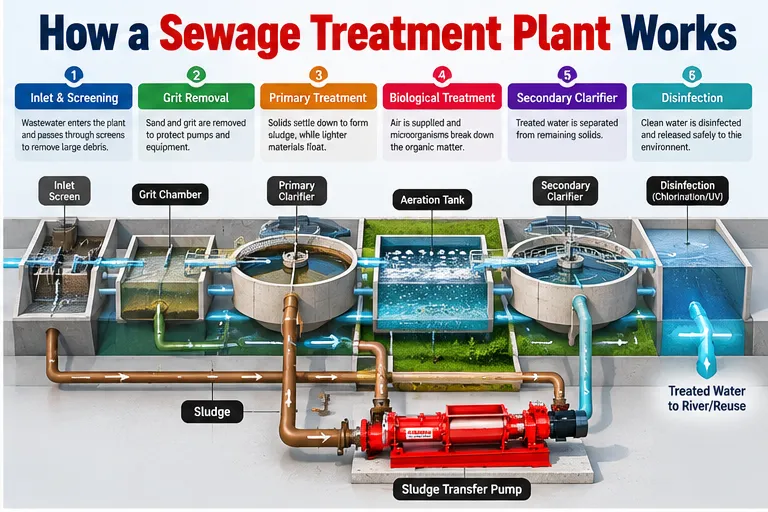
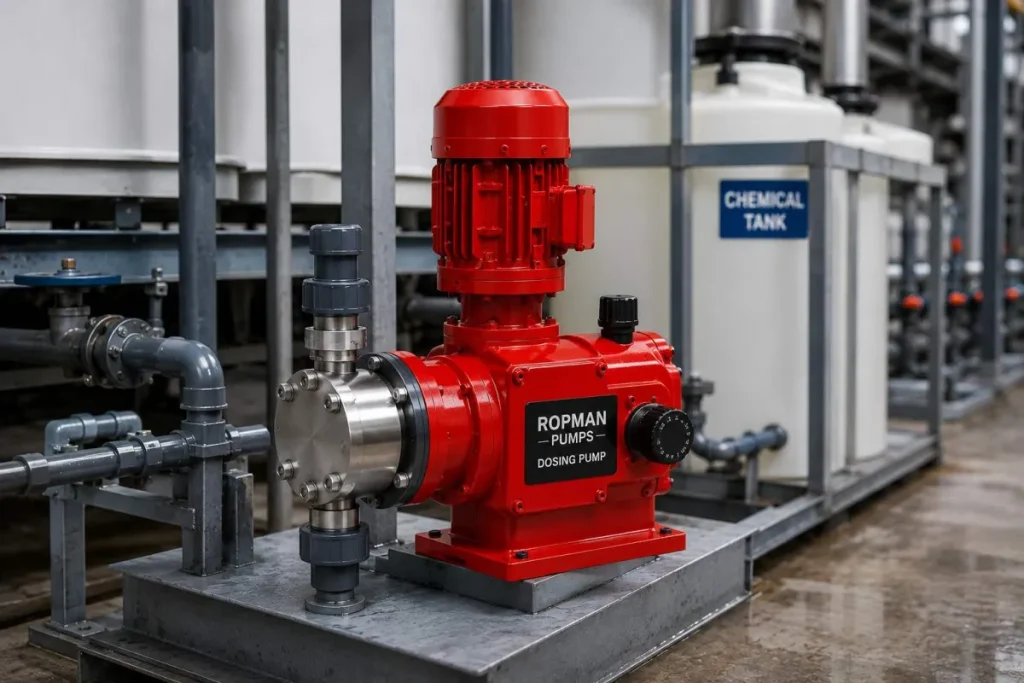
A typical STP plant for apartment use has raw sewage pumps to lift sewage into the plant, transfer pumps from the equalization tank, sludge recirculation pumps, filter feed pumps for tertiary treatment and dosing pumps for chlorine and polymer. Sludge pumps and dosing pumps are where reliability problems usually start.
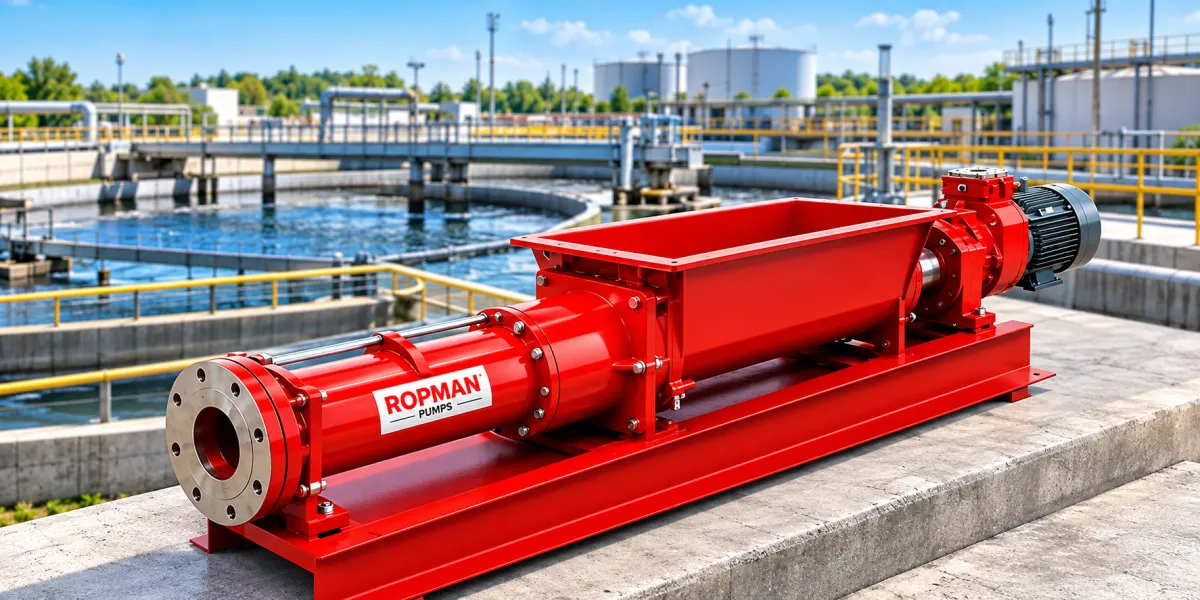
A progressive cavity pump moves thick sludge to the filter press steadily without clogging, while accurate dosing pumps keep chlorine levels right for safe reuse. Ropman manufactures both in Meerut, with in-house spares. See our STP pump guide for every pumping duty, and read more about reclaimed water reuse.
Quick Sizing Table for Housing Societies
Using 4.5 residents per flat, 135 litres per person per day and an 80% sewage factor, these are approximate capacities. Always add staff, clubhouse and commercial loads, and confirm with your consultant.
| Number of Flats | Approx. Population | Sewage Generated | Typical STP Size |
|---|---|---|---|
| 50 | 225 | About 24 KLD | 25–30 KLD |
| 100 | 450 | About 49 KLD | 50–60 KLD |
| 200 | 900 | About 97 KLD | 100–110 KLD |
| 500 | 2,250 | About 243 KLD | 250–275 KLD |
| 1,000 | 4,500 | About 486 KLD | 500 KLD (often in two streams) |
For larger societies, two parallel streams of half capacity each are often better than one big unit. One stream can be shut for maintenance while the other keeps running, and the plant can start with one stream while occupancy is low.
Builder Handover: What RWAs Should Ask For
Many problems with an STP plant for apartment societies begin at handover, when the builder passes the plant to the resident association. Before accepting the plant, ask for these documents and checks.
STP handover checklist:
- Design basis report showing capacity, inlet quality and treated water guarantees
- As-built drawings and process flow diagram
- Valid consent to operate from the State Pollution Control Board
- Recent lab reports of treated water from an approved laboratory
- Equipment list with makes, models, serial numbers and warranty dates
- Operation and maintenance manuals for blowers, pumps and filters
- Spares list and supplier contacts
- A joint trial run showing every pump, blower and filter working
- Records of the last sludge removal and filter media change
If the plant does not perform during the trial, record the issues in writing and agree a timeline for rectification before taking over. Once the RWA accepts the plant, the cost of fixing design shortcuts usually falls on residents.
Resident Awareness: Small Habits, Big Savings
Residents can do more for the STP than any operator. Most blockages and many odour problems come from what goes down the drain. A short awareness note in the society notice board or WhatsApp group helps.
Never Flush
- Wet wipes and diapers
- Sanitary pads and tampons
- Cotton buds, plastics and cloth
- Medicines and paints
Avoid in Kitchen Sinks
- Cooking oil and ghee
- Food scraps and peels
- Tea leaves and coffee grounds
- Strong chemical cleaners in bulk
Oil and grease coat pipes and float as scum in the plant, while wipes and pads wrap around pump impellers and block screens. Every blockage means a call-out, downtime and sometimes damaged equipment.
Making the Most of Treated Water
Treated water is the biggest benefit of an STP plant for apartment communities, yet many societies still drain it away. With proper tertiary treatment and disinfection, it can be used for:
- Toilet flushing through a separate dual plumbing line
- Gardening, lawns and landscape irrigation
- Car washing and floor washing in parking areas
- Make-up water for cooling towers in commercial blocks
- Construction activities in later project phases
Use colour-coded pipes and clear labels for treated water lines, and never connect them to drinking water systems. Monitor residual chlorine so the water stays safe and odour-free in storage.
Basement STPs: Ventilation and Safety
Many urban projects place the STP in a basement or under a podium to save land. This works well with careful design, but it also brings risks that must be managed.
- Ventilation: provide forced exhaust with ducting to roof level so odour and gases do not enter parking areas or lift lobbies.
- Gas safety: sewage can release hydrogen sulphide, which is dangerous in confined spaces. Never enter tanks without gas testing, ventilation and a second person present.
- Lifting access: plan hatches and lifting hooks so pumps and blowers can be removed without breaking slabs.
- Lighting and drainage: good lighting and floor drains make daily checks easier and safer.
- Flood protection: ensure the plant room cannot flood during heavy rain, which can damage blowers and panels.
A good residential STP is invisible to residents: no smell, no noise, and clean water quietly flowing to the gardens.
Frequently Asked Questions
Is an STP plant for apartment projects mandatory in India?
What size STP is needed for 100 flats?
Which STP technology is best for apartments?
How can we stop bad smell from an apartment STP?
Can STP water be used for flushing in apartments?
What documents should an RWA ask for when taking over an STP?
Why does our apartment STP pump keep getting blocked?
Is it safe to have an STP in the basement?
Running an Apartment STP?
Ropman supplies progressive cavity sludge pumps and dosing pumps for residential STPs, with fast spares from Meerut. Tell us your plant size and we will recommend the right pumps.
Request a Quote